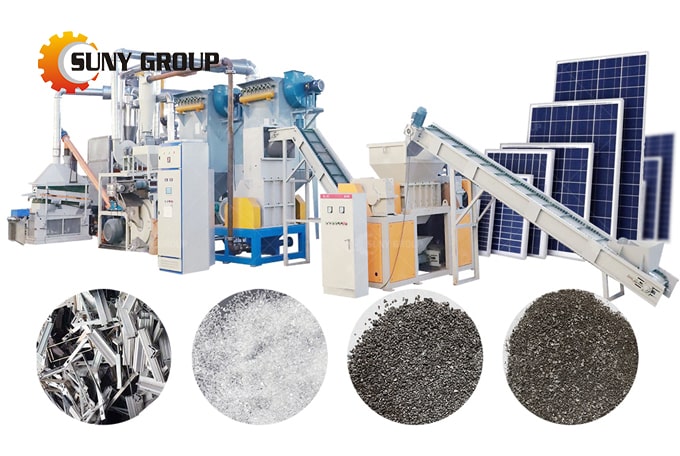
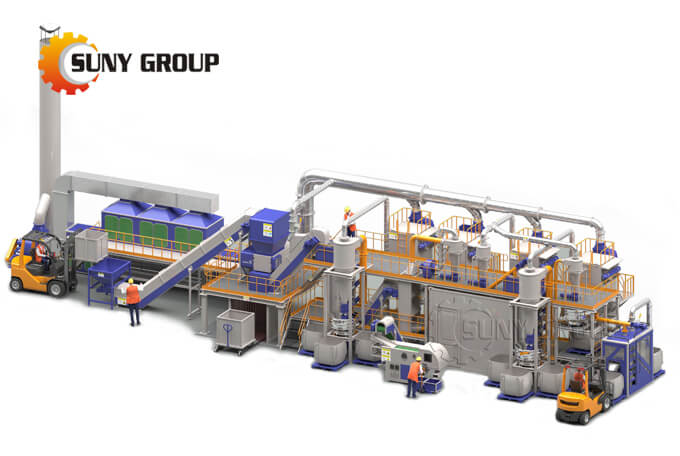
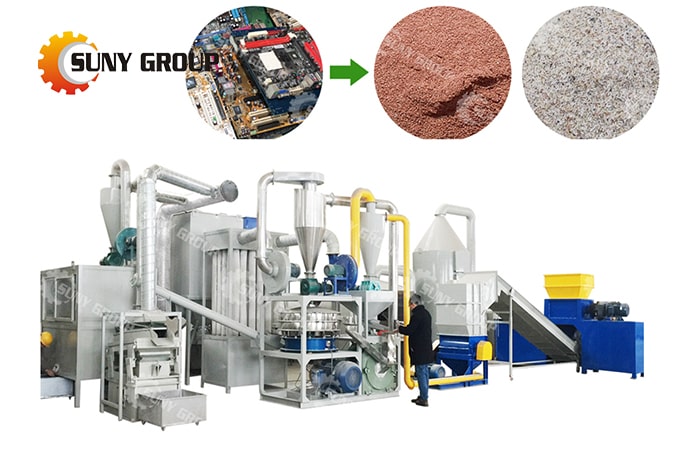
With the rapid development and widespread use of electronic products, discarded electronic waste has emerged as a major global environmental challenge. This electronic waste contains hazardous substances which, if not disposed of properly, can pose serious risks to both the environment and human health. Fortunately, SUNYGROUP’s electronic waste recycling equipment offers the recycling industry an intelligent and highly efficient solution.
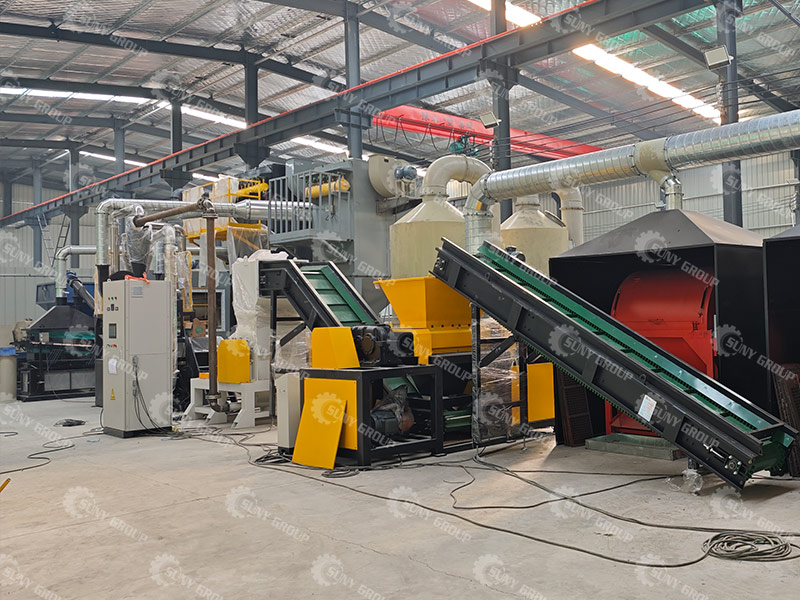
The workflow of this electronic waste recycling equipment primarily comprises the following four core steps:
1. Electronic Component Disassembly: Specialized disassembly machines are used to heat treat discarded circuit boards, thereby melting the solder. Mechanical force is then applied to safely detach electronic components (such as resistors, capacitors, chips, etc.) from the boards, facilitating their separate recovery and classification.
2. Multi-Stage Crushing: Primary Shredding: The baseboards remaining after disassembly are fed into a dual-shaft shredder, where they undergo initial shredding into smaller chunks. Secondary Crushing: The coarsely shredded material then enters a hammer mill or knife crusher, where it is further ground down to fine particles of 2–3 mm in size, ensuring the complete dissociation of metallic and non-metallic materials.
3. Magnetic Separation and Classification: Iron Removal: The crushed mixed particles pass through a magnetic separator, which extracts and separates internal ferromagnetic substances (such as certain screws or iron pins). Screening: The material then enters a gyratory vibrating screen for particle size classification. Oversized particles are returned to the crusher for further processing, while particles meeting the specified size criteria proceed to the next stage of separation.
4. Airflow and Electrostatic Separation: Airflow Separation: By leveraging differences in specific gravity and density, an airflow system is utilized to achieve a preliminary separation of lighter non-metallic powders (such as resins and glass fibers) from heavier metallic particles. High-Voltage Electrostatic Separation: The material, having undergone airflow separation, enters an electrostatic separator. By exploiting differences in electrical conductivity—where metals like copper are conductive while resins are non-conductive—a high-voltage electric field is employed to achieve a pure separation of metallic from non-metallic materials; typically, the recovery rate for copper exceeds 99%.
Suny Group : http://www.sunyrecycle.com/,All rights reserved。
Share This News, Choose Your Platform!
Welcome to visit Suny Group website. If you are interested in our equipment, please feel free to contact us!