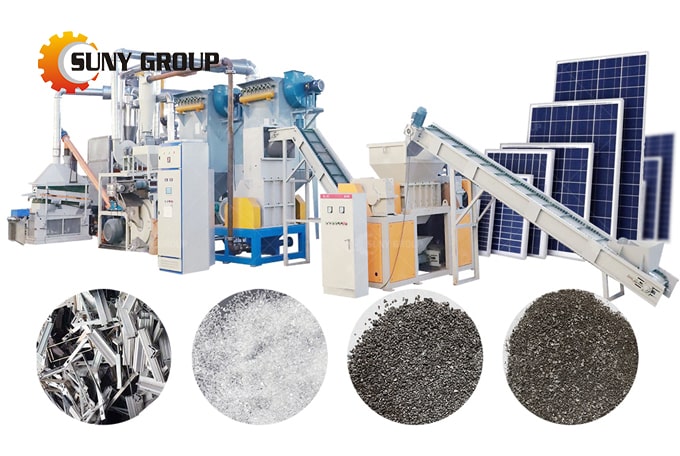
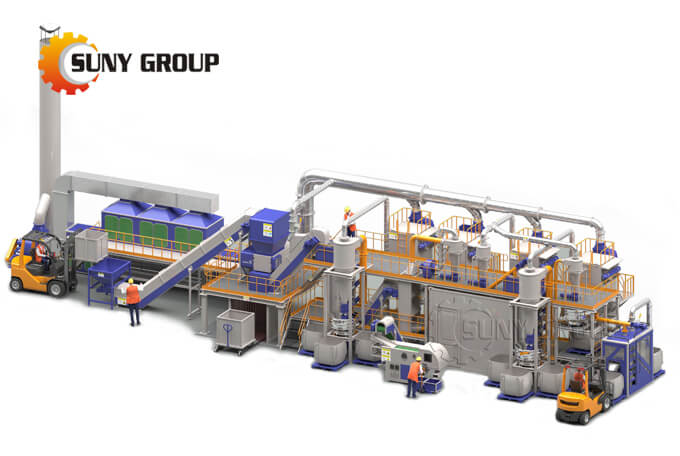
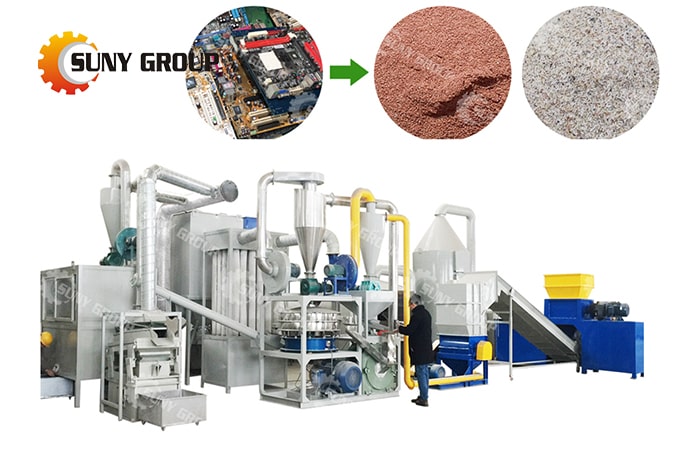
The valuable materials contained in waste lithium batteries, such as copper, aluminum, and black powder, represent the value of the recycling industry. SUNY GROUP's lithium battery recycling equipment production line features a comprehensive processing system comprising four main processes: physical crushing, charged crushing, low-temperature drying, and high-temperature pyrolysis. From material pretreatment to final separation, each step is precisely adapted to the material characteristics, ensuring efficient separation of various valuable materials and meeting the actual production needs of recycling companies.
In the pretreatment stage, the low-temperature drying process of the production line plays a crucial role. In a sealed environment at 80-120℃, the electrolyte and moisture inside the battery are slowly removed. This process not only prevents electrolyte leakage and contamination during subsequent crushing but also facilitates the separation of the black powder in the electrode core from the copper and aluminum current collectors, thereby reducing resistance during subsequent separation. For undischarged batteries, the production line's charged crushing module can directly process them. By controlling the oxygen content through nitrogen protection, the crushing equipment safely crushes the charged batteries, avoiding short-circuit risks while dismantling the batteries into initial forms such as shells and electrode core fragments, eliminating the need for an additional discharge process and saving processing time.
The physical crushing and high-temperature pyrolysis stages work in synergy. Physical crushing first separates the battery shell and electrode core using a coarse crusher; the shell is then screened and recycled separately; the electrode core enters a fine crusher and is refined into small particles, allowing for the initial separation of the positive and negative electrodes and the separator. Subsequently, the finely crushed material enters a high-temperature pyrolysis furnace. In an inert gas environment at 400-600℃, the separator and organic binder are fully decomposed. The decomposition products can be recycled after purification, while the black powder and copper and aluminum particles remain intact, and their bonding force is significantly reduced, creating favorable conditions for subsequent separation.
The separation stage employs a multi-equipment linkage mode. Airflow separation equipment first separates the lightweight black powder from the heavier copper and aluminum particles. The collected black powder meets the purity requirements for regeneration; the mixed copper and aluminum particles then enter a gravity separation device, and by adjusting the separation parameters, effective separation of the two metals is achieved, maintaining a stable recovery rate. At the same time, iron impurities in the casing are removed through magnetic separation to ensure the purity of the recycled casing, and the diaphragm decomposition products are collected through a dedicated channel, enabling the classified processing of all materials.
Suny Group : http://www.sunyrecycle.com/,All rights reserved。
Share This News, Choose Your Platform!
Welcome to visit Suny Group website. If you are interested in our equipment, please feel free to contact us!