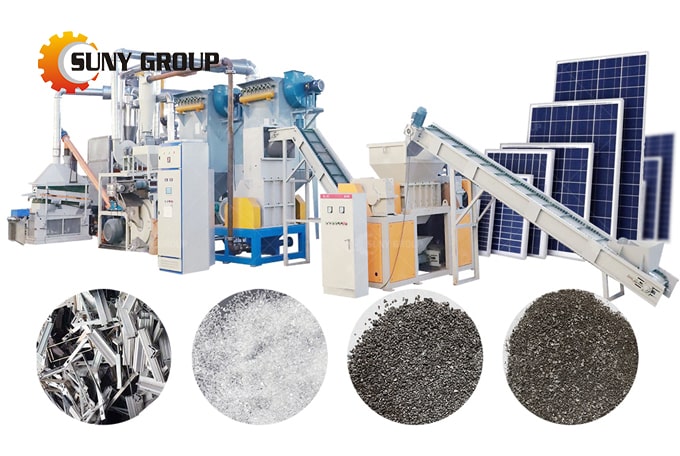
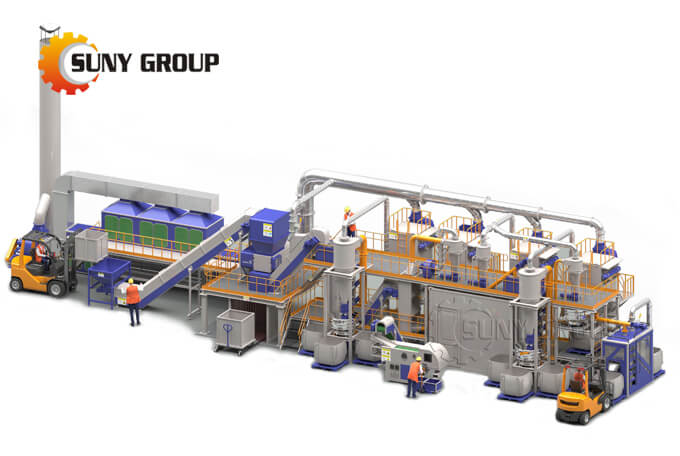
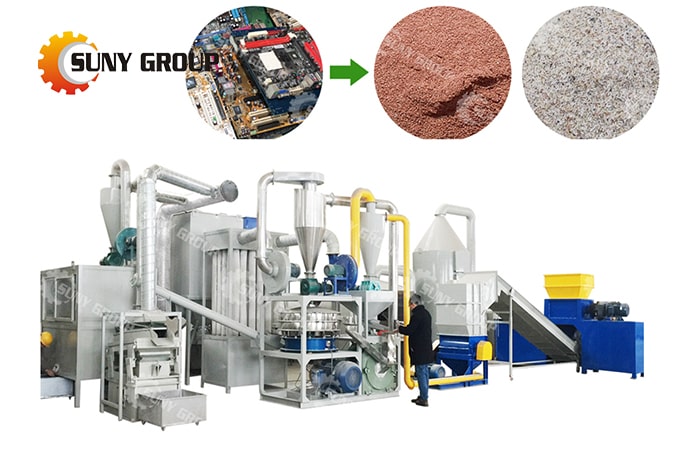
As the volume of decommissioned photovoltaic (PV) modules increases year by year, production lines for PV panel recycling and dismantling—serving as critical equipment for resource circularity—are attracting growing attention from industry professionals. What are the core processes involved in a PV panel recycling line? And what are the final outputs? As a specialized manufacturer of PV panel recycling equipment, SUNYGROUP offers you the most professional insights:
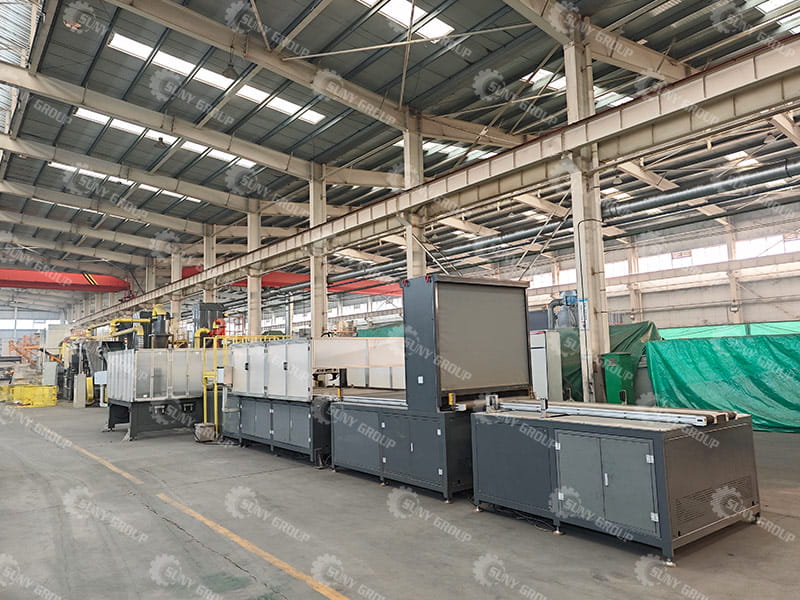
Core Processes of a PV Panel Recycling Line:
Feeding and Pre-treatment Unit: Includes conveyor belts, positioning devices, and automated or semi-automated workstations for dismantling aluminum frames and junction boxes.
Crushing and Screening Unit: Utilizes flexible crushing equipment, paired with multi-layer vibrating screens, to achieve the preliminary separation of glass from metals and plastics.
Pyrolysis Treatment Unit: Decomposes polymeric materials—such as EVA encapsulant films—through precise temperature control within an oxygen-free or oxygen-limited environment.
Sorting and Purification Unit: Employs specific gravity separation, electrostatic separation, or optical recognition technologies to finely classify the mixed materials resulting from the crushing process.
Waste Gas Treatment System: Collects gases generated during the pyrolysis process, subjecting them to combustion, cooling, dust removal, and other treatments to ensure emissions meet regulatory standards.
The true value of a PV panel recycling and dismantling line is reflected in its outputs—specifically, whether the processed recycled materials can enter downstream markets at a reasonable price. A high-quality PV panel recycling line typically yields the following five main categories of products:
1. Glass Granules
These account for approximately 75% of the total weight of the PV module. Downstream glass manufacturers or building material factories typically impose the following key requirements on recycled glass: low EVA residue content (usually required to be below 0.5%), low iron content (to prevent glass discoloration), and uniform particle size. Glass meeting these criteria can serve as a cullet substitute for a portion of the quartz sand used in the production of new glass, foam glass, or construction aggregates.
2. Aluminum Materials
Derived from the frames of the PV modules. The value of recycled aluminum lies in its purity—specifically, avoiding the contamination of impurities such as iron or copper during the dismantling process. After smelting, the aluminum materials produced by the line can be cast into recycled aluminum ingots, which are then utilized in processes such as die-casting and extrusion—applications that are essentially identical to those of primary (virgin) aluminum.
3. Copper Granules
Sourced from the internal solder ribbons and busbars within the PV modules. Copper possesses a high recycling value, though its market value is highly sensitive to purity levels. Following sorting, the copper-bearing material typically boasts a copper content exceeding 98% and can be sold directly to copper smelters or copper processing enterprises.
4. Silver-bearing Silicon Powder
This constitutes the most valuable output of the entire production line. Photovoltaic cells contain silver electrodes; after undergoing pyrolysis and crushing, the silver and silicon form a mixed powder. Downstream hydrometallurgical enterprises can extract silver with a purity exceeding 99% from this material through processes such as acid leaching and displacement. The silicon powder, meanwhile, can be utilized for the production of industrial silicon or serve as an auxiliary metallurgical material.
Suny Group : http://www.sunyrecycle.com/,All rights reserved。